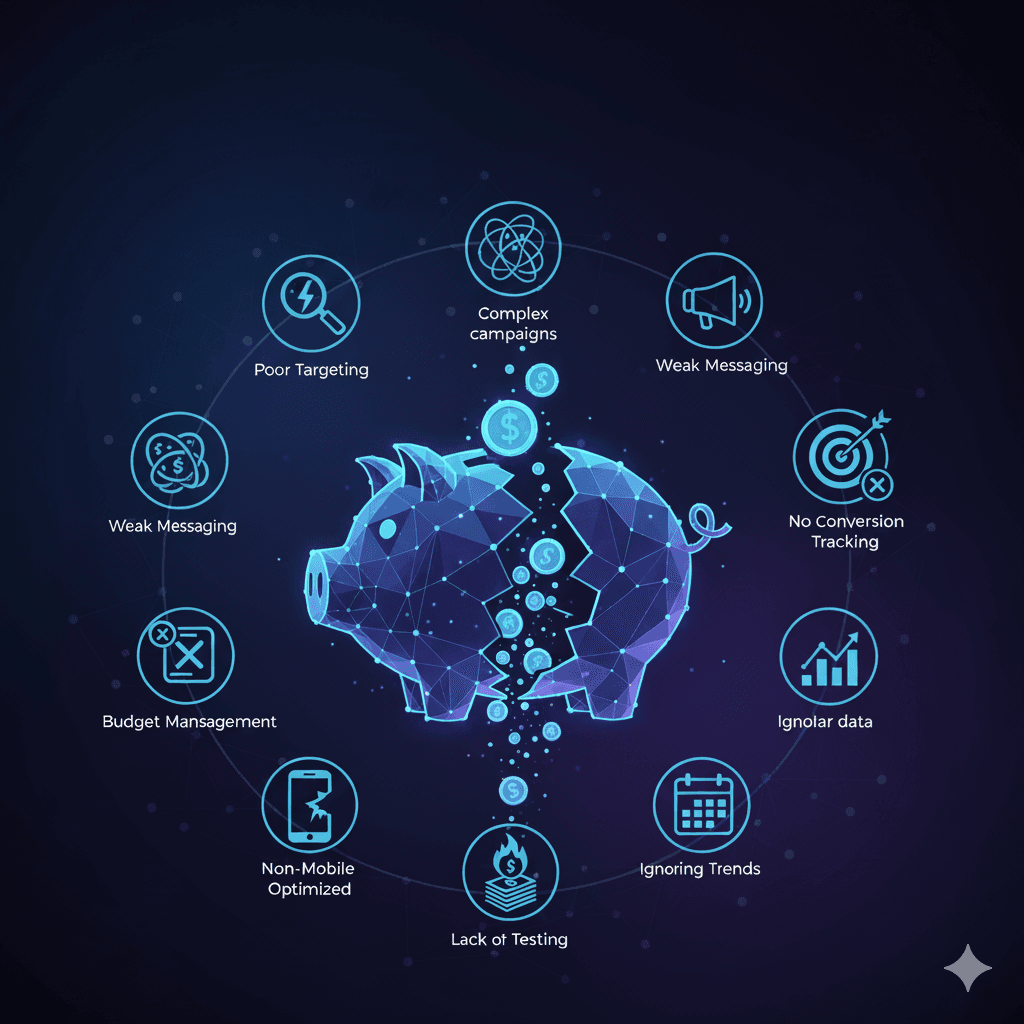
Top 10 Digital Marketing Mistakes That Waste Your Ad Budget
Top 10 Digital Marketing Mistakes That Waste Your Ad Budget
Top 10 Digital Marketing Mistakes That Waste Your Ad Budget
Digital marketing can either skyrocket your business growth or drain your ad budget fast — depending on how well you execute your strategy. Many businesses pour thousands into ads every month, only to see minimal returns. Why? Because they fall into common traps that waste both money and opportunity. In this in-depth guide, we’ll explore the top 10 digital marketing mistakes that silently kill your ROI and reveal actionable ways to fix them before your next campaign.
1. Ignoring Audience Targeting — The Costliest Mistake
If you’re trying to reach everyone, you’ll end up reaching no one. One of the biggest reasons ad budgets get wasted is poor audience targeting. Businesses often cast their nets too wide, spending money on clicks from users who have zero interest or intent to buy. Platforms like Google Ads, Facebook Ads, and LinkedIn offer advanced audience segmentation features — but many marketers fail to use them properly.
Instead of targeting generic audiences, focus on building buyer personas based on demographics, interests, and behaviors. Use custom audiences to target website visitors or email subscribers. Refine your campaigns with lookalike audiences to scale effectively without losing relevance.
2. Neglecting Conversion Tracking
Running ads without proper conversion tracking is like flying blind. You may know how much you’re spending but have no idea what’s working. Tools like Google Analytics, Meta Pixel, and UTM parameters let you track where your sales and leads are coming from.
Without this data, you can’t optimize campaigns effectively. Every marketer should know their cost per acquisition (CPA), conversion rate, and return on ad spend (ROAS). Review these metrics weekly to reallocate your budget toward the highest-performing ads.
3. Poor Landing Page Experience
Imagine spending $1,000 on ads — only for users to bounce seconds after landing on your page. That’s the reality for many businesses that neglect their landing pages. Even the most persuasive ads can’t save a slow, confusing, or irrelevant landing page.
A high-converting landing page should load in under 3 seconds, be mobile-responsive, and have a clear CTA (call to action). Avoid clutter, use persuasive headlines, and match the message of your ad to the page content. A/B testing tools like Google Optimize or VWO can help you refine your design and improve results.
4. Overlooking Mobile Optimization
More than 70% of ad clicks now come from mobile devices — yet many businesses still prioritize desktop designs. If your mobile experience is poor, you’re literally wasting ad spend. Slow-loading images, small buttons, or broken layouts can make users abandon your site instantly.
Test your ads and landing pages on multiple devices before launching. Use Google’s Mobile-Friendly Test to spot issues and fix them. Compress images, simplify forms, and ensure CTAs are easy to tap. Remember, mobile-first isn’t optional anymore — it’s essential.
5. Focusing on Vanity Metrics Instead of Conversions
High impressions and likes might look good on paper, but they don’t pay the bills. Many marketers make the mistake of chasing vanity metrics instead of focusing on actual conversions. A campaign that drives 1,000 likes but no sales is a failure — no matter how viral it looks.
Define your goals clearly: Is it lead generation, sales, or awareness? Align your metrics accordingly. For sales, measure cost per conversion. For brand awareness, track reach and frequency. The key is to measure what matters for your business, not what inflates your ego.
6. Not Testing Ad Creatives
Running one ad version and expecting great results is like buying one lottery ticket and hoping to win. Creative fatigue happens fast — especially on social platforms. If your audience sees the same ad repeatedly, engagement drops and costs rise.
Always A/B test your visuals, copy, and CTAs. Try different headlines, colors, and offers. Rotate creatives regularly to prevent ad fatigue. Tools like Meta’s Dynamic Creative Optimization or Google Ads Responsive Search Ads can automatically test variations for better performance.
7. Ignoring Remarketing Campaigns
Up to 97% of first-time visitors don’t convert — yet most businesses never retarget them. Remarketing is one of the most cost-effective ways to recover lost conversions. By showing tailored ads to users who visited your site but didn’t take action, you can drastically improve ROI.
Set up remarketing pixels on your site and create segmented audiences — such as ‘Cart Abandoners’ or ‘Viewed Pricing Page.’ Then, offer personalized incentives like discounts or reminders. These warm audiences are far more likely to convert than cold traffic.
8. Failing to Optimize Ad Frequency and Timing
Bombarding your audience with ads too often can lead to ad fatigue, annoyance, and wasted budget. Conversely, showing them too infrequently can make your campaign invisible. The key lies in balance.
Analyze your ad frequency in analytics dashboards. If users see your ad more than five times without converting, it’s time to refresh your creatives. Also, study your peak engagement hours and schedule ads accordingly. Platforms like Facebook Ads Manager let you control when your ads appear — use that to your advantage.
9. Not Aligning Messaging Across Channels
Your brand’s messaging should stay consistent whether a user finds you through Instagram, Google, or email. A disjointed experience confuses potential customers and weakens trust. For instance, if your ad promotes a 20% discount but your website doesn’t reflect it, users will bounce immediately.
Create unified campaign messaging. Use consistent visuals, tone, and offers across all channels. That cohesion improves brand recall and ensures your audience feels confident and connected — no matter where they encounter your business.
10. Neglecting Continuous Learning and Optimization
Digital marketing isn’t a ‘set it and forget it’ process. Algorithms, platforms, and user behaviors evolve constantly. What worked six months ago might not work today. Businesses that stop testing and learning stagnate — and their ROI plummets.
Schedule regular campaign audits. Review keyword performance, creative trends, and conversion funnels. Stay updated with new features from Google, Meta, and TikTok. Join marketing forums, follow thought leaders, and experiment with emerging strategies. Continuous optimization is the secret weapon of every successful marketer.
Bonus Tip: Combine Automation with Human Insight
AI tools like Google’s Performance Max or Meta’s Advantage+ campaigns are great for automation — but they still need human strategy. AI can optimize bids and placements, but it can’t understand your brand story or customer psychology. Use automation for efficiency, but rely on human insight for emotional connection and creativity.
Final Thoughts: Every Click Counts
Every wasted click is lost revenue. The difference between a profitable campaign and a money pit often comes down to attention to detail. By avoiding these 10 common digital marketing mistakes — from poor targeting to neglecting testing — you’ll not only save money but also build a stronger, more consistent brand presence online.
Remember: Smart marketing isn’t about spending more; it’s about spending wisely. Analyze, test, and refine. The brands that master continuous optimization are the ones that dominate the digital landscape — without burning through their ad budgets.